Crypto Market Stretch
The Blockchain Sector 2026-03-17
Bitcoin Bounces, ETH Wakes Up & Strategy Finds A New Way To Buy BTC
Bitcoin is up ~25% from its February low.
Rate cut expectations are firming, dollar liquidity is expanding, and the narrative around Bitcoin as a treasury asset is no longer fringe.
Meanwhile ETH is quietly outperforming with ETH/BTC back above 0.03. When this ratio climbs, it usually signals one of two things: either ETH has specific catalysts driving rotation, or the risk-on mood is broadening beyond Bitcoin. Right now it looks like the latter.
Then there is Stretch (STRC) by Microstrategy which was responsible for pumping over a billion dollars into Bitcoin last week alone.
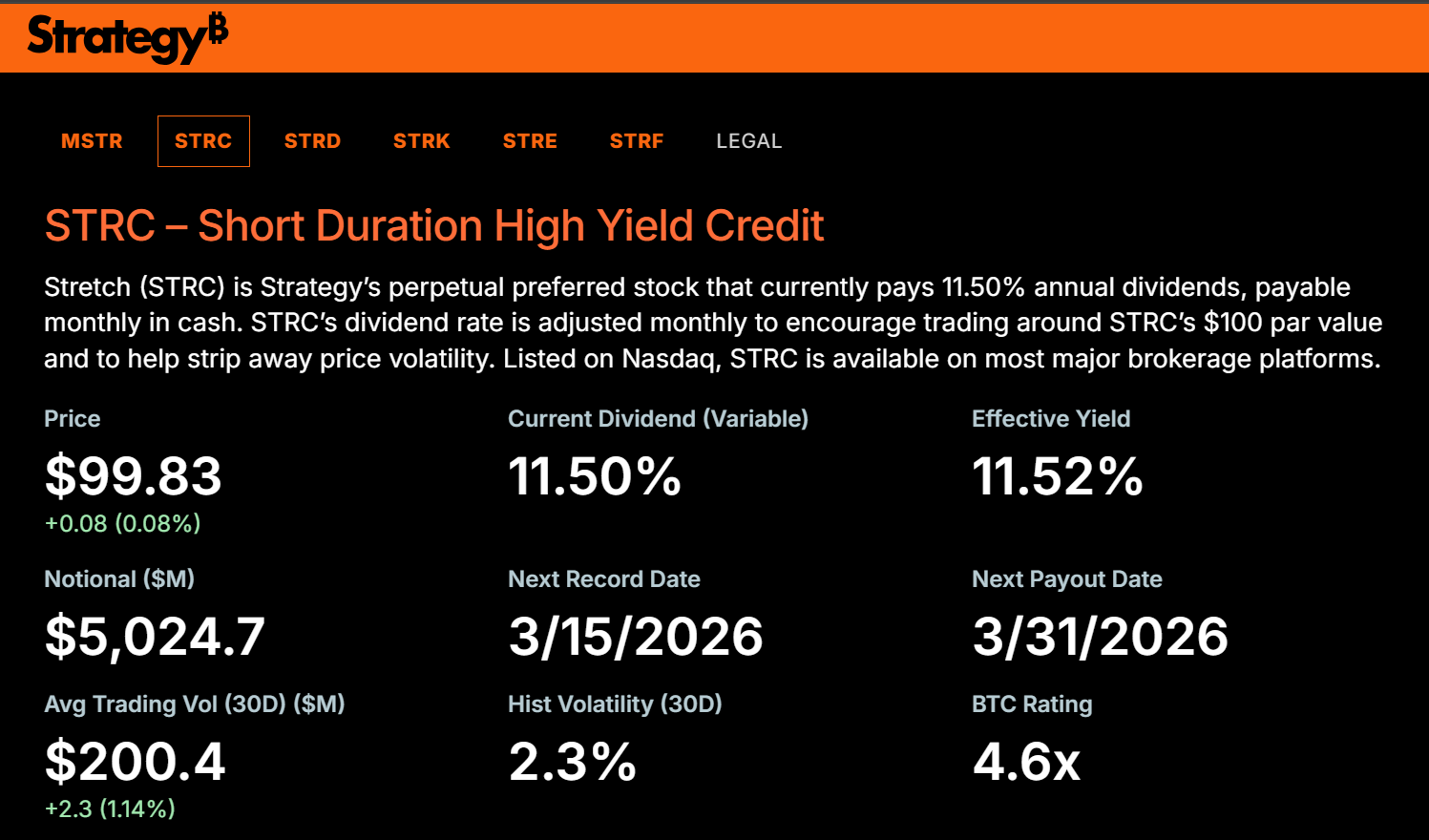
Value proposition: Fixed income 11.5% annual yield, paid monthly. On the surface it looks like a boring income product but there is an underlying mechanism that affects markets. Fixed income investors buy STRC for yield. Strategy takes that capital and buys Bitcoin. More demand for STRC = more BTC purchases. It’s a flywheel that converts fixed-income demand directly into BTC demand.
It’s an interesting yield product but it’s a more interesting and very valuable flow of capital into crypto creating a permanent bid for Bitcoin funded by institutional credit markets. Pension funds, family offices, and income focused allocators who would never touch spot BTC will happily buy a 11.5% yielding preferred share from a listed company. Strategy then converts that demand into Bitcoin at any price.
If this scales to tens of billions, it becomes a structural buyer that operates independently of retail cycles, ETF flows, or macro fear. That’s genuinely novel and something to be grateful for.
The risk is the model works in reverse if confidence breaks. Comparisons have been drawn to the Luna/UST death spiral. Bitcoin underperforms, Strategy’s balance sheet weakens, the yield needs to rise to maintain demand, funding costs climb causing balance sheet to weaken... It’s not something that can collapse overnight though like Luna did, a greater risk is a long-term bear market for Bitcoin which would mean everything goes to 💩 anyway.
With Bitcoin 25% off the lows and institutions clearly searching for yield, STRC looks well timed. Watch the issuance volumes (currently $5B as of 17th March) over the coming weeks and months. If the market absorbs it at scale, you’ll understand why Bitcoin’s drawdowns got shallower creating less downside risk.
The market pendulum spends little time in the middle.



The dominant theme across today’s news cycle is the intensifying Iran war and its cascading effects on global energy markets, macro stability, and geopolitics. Oil has spiked above 3% as Iranian forces escalate drone attacks on Gulf infrastructure — Brent crude near $102/bbl, WTI near $96 — and the IMO has warned that naval escorts will not guarantee safe passage through the Strait of Hormuz. Against this backdrop, crypto markets are rallying sharply: Bitcoin briefly tested $75,000 (a six-week high) on a derivatives-driven short squeeze with $485M in short liquidations and a six-day ETF inflow streak worth ~$1B. Nvidia’s GTC conference provided a further tailwind, with Jensen Huang announcing $1 trillion in Blackwell/Vera Rubin orders through 2027 and framing agentic AI as the dominant near-term paradigm. Regulatory shifts in US crypto continue to accelerate, while Moody’s has issued a stark recession warning tied to sustained energy prices.
1. Iran War Escalates — Oil Above $100, Strait of Hormuz at Risk
Iranian drone strikes hit UAE oil infrastructure (Abu Dhabi installation and a tanker off Fujairah), sparking fires and pushing oil prices up more than 3%. The IMO chief warned that naval escort plans for Strait of Hormuz shipping “will not guarantee safe passage,” undermining US-backed protection efforts for the chokepoint through which ~20% of global oil supply transits. Tehran is preparing for the Persian new year under air assault; the US military has turned to intercepting Iranian patrol boats operationally. Two FT deep-dives analyse the strategic picture: Saudi Arabia’s détente with Iran has fully unravelled, and analysts conclude Iran retains advantages of geography, time, and pain tolerance despite taking a military beating.
Moody’s warned that a recession will be “hard to avoid” if oil prices remain elevated for even a few more weeks. The Felder Report flagged the return of stagflation — slowing growth meeting rising energy prices — as the dominant macro risk. US stocks have shown surprising resilience, partly because analysts are still raising earnings forecasts. Opportunity: energy-linked assets and inflation hedges (gold, commodities, BTC digital-gold narrative) may benefit from continued escalation. Content opportunity: oil-driven crypto correlation analysis.
FT: Oil jumps as Iran steps up attacks on infrastructure
2. Bitcoin Tests $75,000 on Short Squeeze — Crypto Majors Post Double-Digit Weekly Gains
Bitcoin briefly surged past $75,000 — a six-week high — driven by $609M in crypto liquidations ($485M shorts), then quickly pulled back, underscoring fragility in the move. BTC ETFs posted a six-day inflow streak worth approximately $1B since March 9. The broader crypto market is up strongly for the week: ETH +13%, XRP +11%, SOL +9.7%. $767M in ETF inflows and Iran ceasefire speculation appear to be driving the broadest rally in months. XRP broke $1.50 resistance on a 125% volume spike, pushing market cap to $93.4B and flipping BNB in open interest as Binance futures OI rebuilds toward pre-crash levels.
The rally comes despite macro headwinds, suggesting crypto is being treated as a risk-on inflation hedge ahead of a Federal Reserve decision. The derivatives-led nature of the move means it is vulnerable to reversal, but sustained ETF inflows provide underlying spot demand. Opportunity: if the Fed signals a hold or cut, the next leg higher could follow quickly.
CoinDesk: Crypto majors post double-digit weekly gains as bitcoin tests $75,000
3. Nvidia GTC: Jensen Huang Announces $1 Trillion in Orders Through 2027
Jensen Huang’s GTC 2026 keynote centred on a $1 trillion sales backlog for Blackwell and Vera Rubin chips through 2027, cementing Nvidia’s position as the infrastructure backbone of the AI build-out. He unveiled OpenClaw (an open-source robotics/physical AI framework), the Vera CPU (custom ARM-based server processor designed to pair with Nvidia GPUs), and framed agentic AI — not inference — as the dominant near-term paradigm driving the next wave of GPU demand. The announcement drove surges in AI-linked crypto tokens and Asian tech stocks.
The scale of demand signals AI infrastructure spending is far from slowing even amid macro uncertainty. Opportunity: the robotics/physical AI theme (healthcare datasets, warehouse automation) is emerging as the next wave. Content opportunity: deep-dive on Vera Rubin architecture and the transition from inference to agentic AI workloads.
Latent Space: NVIDIA GTC — Jensen goes hard on OpenClaw, Vera CPU, $1T backlog
4. DeFi Lobby Drops SEC Airdrop Lawsuit — Regulatory Shift Accelerating
The DeFi Education Fund voluntarily dismissed its lawsuit against the SEC over airdrop token classification, citing a “changed regulatory environment” under the new administration. The dismissal was without prejudice — it can be refiled — but signals that the industry believes regulatory pressure has reduced enough that litigation is unnecessary for now. This follows a string of SEC case withdrawals across the sector.
For DeFi protocols, this signals reduced legal risk for token distribution mechanisms previously treated as unregistered securities. Opportunity: protocols previously constrained by legal risk may now re-engage US users; airdrop activity could accelerate. Relevant for Stellar/Soroban ecosystem positioning.
CoinTelegraph: DeFi lobby drops airdrop lawsuit against SEC
5. $50M DeFi Swap Disaster — Aave and Cow Protocol Post-Mortems
Dueling post-mortems from Aave and Cow Protocol detail how a $50 million DeFi swap went from bad to catastrophic through a combination of oracle manipulation, liquidity fragmentation, and MEV extraction that compounded losses far beyond the initial failure point. The post-mortems reveal systemic fragility in large-scale DeFi composability under adverse market conditions.
This is a high-signal warning: as transaction sizes scale and protocols compose more deeply, failure modes become harder to anticipate. Opportunity: audit tooling, circuit-breaker mechanisms, and DeFi insurance products address a clearly demonstrated need. Content opportunity: explainer on DeFi composability risks.
Unchained Crypto: How a $50M DeFi swap went catastrophic
6. Messari Goes AI-First, CEO Steps Down, Layoffs Hit Crypto Data Sector
Messari announced a pivot to “AI-first” under new CEO Diran Li, cutting staff alongside the strategic shift. This is part of a broader wave of crypto-adjacent company layoffs (OP Labs, Block Inc., Gemini also cutting). The Messari pivot reflects the broader pattern of crypto infrastructure companies repositioning around AI tooling as the primary value driver.
The consolidation in crypto data and analytics creates a gap for AI-native competitors. Opportunity: AI-powered on-chain analytics and intelligence tooling is underserved as incumbents restructure.
TheBlock: Messari CEO steps down, new AI pivot



Social links are below and if you enjoyed this newsletter I would appreciate it if you could share this content